Grace Eye

Personal Leadership Portfolio

Explore My Portfolio

Introduction

This personal leadership portfolio shows my growth throughout this course and my development as a student, worker, volunteer, and creative person. It includes my leadership philosophy, personal goals, management skills, transferable skills, self-assessments, and artifacts that show evidence of my learning and experience.


The them I chose focuses on my growth through communication, creativity, and responsibility. I specifically chose this theme because many of my experiences connect to working with others, solving problems, staying organized, and learning how to contribute my skills in very different environments and cultures. This portfolio is not only about what I have done, but also about what I have learned about myself as a developing leader.

My Personal Leadership Philosophy

My leadership philosophy is that real leadership comes from understanding people deeply, communicating honestly, and creating environments where people feel safe enough to grow.


I’ve realized that I naturally approach leadership in a very observant and reflective way. Before reacting to situations, I usually try to understand the emotions, intentions, and perspectives behind people’s actions first. I think leadership becomes unhealthy when it is based only on control, authority, or performance without emotional awareness. To me, leadership is more about understanding people psychologically and helping them feel genuinely supported while still encouraging growth and accountability.


Throughout this course, I became more aware of how communication affects trust, motivation, and group dynamics. Small misunderstandings can completely change the atmosphere of a team, especially when people feel unheard or emotionally disconnected. Because of this, I value communication that is calm, clear, emotionally aware, and honest rather than aggressive or overly controlling.


I also think leadership requires a balance between empathy and responsibility. Understanding people is important, but so is maintaining standards and helping others move forward. My goal is to become someone who can create stability, emotional safety, and motivation in both creative and professional environments while continuing to grow emotionally and intellectually myself. This to me connects to Maslow’s Hierarchy of Needs, which explains that people need basic safety and belonging before they can fully reach their potential. In leadership this reminds me that people are not motivated only by tasks or expectations but they also need to feel secure and included. As a leader I want to create environments where people’s basic emotional and social needs are met so they can become more motivated, and capable of growth.

My Leadership Quote

“Do what you love, and success will follow. Passion is the fuel behind a successful career.”

Source: Meg Whitman


I chose this quote because it connects strongly to my interests, goals, and personal development. I believe people are more motivated and successful when they genuinely care about what they are doing. Passion helps people stay committed, continue improving, and overcome challenges even when situations become stressful or difficult.


This quote also connects to leadership development because strong leaders are often passionate about their goals, work, and values. Passion can inspire other people, improve teamwork, and create a more positive environment. In this course, I learned that motivation is an important part of leadership, and people tend to perform better when they feel interested, encouraged, and connected to their work.


This quote reminds me of how I want my future career to connect to creativity, communication, and meaningful work. Since I am interested in graphic design and visual communication, this quote reminds me that success is not only about achievement, but also about doing work that feels personally fulfilling and motivating.

I also chose it because I naturally aim high for myself and for my future. I want to build a career that feels meaningful, creative, and personally fulfilling rather than simply doing something only for external success. Since I am interested in graphic design and visual communication, this quote reminds me that passion and ambition often work together. I think people are more likely to succeed long-term when they genuinely care about what they are creating and continue pushing themselves to grow.

My Vision & Mission

My vision is to become more confident in my skills, independent, and creative person who uses communication, design, and leadership skills to make a positive impact in work and personal environments.

My mission is to continue developing my creativity, responsibility, communication, organization, and problem-solving skills while gaining experiences that prepare me for future education, career opportunities, and leadership roles.


My vision explains the direction I want my life to move in. I want to become more confident in myself and more capable of handling responsibility. Since I am interested in graphic design and communication, I want my future work to combine creativity with practical skills. My mission explains what I am doing now to move toward that future.

My Goals & Plans

My goals are organized into immediate, medium-range, and long-range goals. I tried to make them realistic and connected to my personal development, education, and career interests.

  • Complete this course successfully and submit a complete leadership portfolio.
  • Improve my time management by breaking larger assignments into smaller steps.
  • Continue building confidence in group work, communication, and leadership situations.
  • Gain more school, work, or volunteer experience that develops responsibility and teamwork.
  • Improve my graphic design portfolio by adding stronger visual projects and examples.
  • Continue developing communication skills in both in-person and online environments.
  • Pursue a meaningful creative career path, especially one connected to graphic design or visual communication.
  • Become more independent financially, personally, and professionally.
  • Use my leadership, creativity, a,nd communication skills to contribute positively to future workplaces or communities.

These goals connect to leadership because they require planning, self-discipline, and reflection. They also show that leadership is not only about managing other people; it is also about managing myself, making responsible choices, and continuing to improve over time.

My Personal Leadership Development

One of the biggest things I learned throughout this course is that leadership is much more psychological than I originally thought. Before this class, I mostly associated leadership with authority, confidence, or being the person in charge. Now I understand that leadership also involves emotional regulation, communication, adaptability, trust, motivation, and understanding how people function individually and within groups.


I would describe my leadership style as reflective, emotionally aware, observant, and supportive. I tend to notice patterns in people’s behaviour and group dynamics very quickly, which helps me understand situations beneath the surface level. Rather than reacting impulsively, I usually try to understand why people feel or behave the way they do first. I think this can be a strength because it allows me to approach situations more thoughtfully and avoid unnecessary conflict.


At the same time, this course also made me reflect on areas where I still want to grow. Because I naturally think deeply about situations, I can sometimes overanalyze or hesitate before acting. I want to continue developing confidence in leadership situations so I can trust my own judgment more quickly and communicate my ideas more directly when needed.


I connect most strongly with transformational leadership because I believe people perform best when they feel understood, encouraged, and emotionally connected to what they are doing. I don’t think fear or pressure creates healthy long-term motivation. I think people grow more when they feel respected, inspired, and emotionally safe enough to contribute honestly.


Leadership is important to me because leadership affects people emotionally, not just practically. A leader can completely influence the atmosphere of a group, the confidence of individuals, and the way people experience work, school, or collaboration. Through this course, I became more aware of the type of environment I want to create around me: one that feels emotionally intelligent, communicative, creative, and stable rather than stressful or disconnected.
My Management Skills

The four functions of management are planning, organizing, leading, and controlling. I have developed these skills through school projects, customer service, volunteering, illustration work, and design-related experiences.

1. Planned visual projects for my Sports Marketing course, including posters, logos, and social media content.

2. Managed illustration tasks for Aquavie Mouvance by completing visuals over time and meeting project expectations.

3. Planned school work and deadlines so I could balance multiple responsibilities.

1. Organized and stocked sales floor and donation areas while volunteering with Habitat for Humanity.

2. Kept workstations clean and organized while working in a fast-paced Tim Hortons environment.

3. Organized visual materials, notes, and project files for design and marketing assignments.

1. Used clear communication with customers and team members in customer-service settings.

2. Contributed to teamwork by supporting organized work areas and helping daily operations run smoothly.

3. Took responsibility for creative work by producing clear visuals that helped clients understand movement and exercise techniques.

1. Checked my design work for consistency, clarity, and accuracy before completing projects.

2.. Adjusted my work based on assignment expectations, feedback, and project goals.

3. Maintained standards in customer service, food preparation, and visual work by paying attention to quality and details.


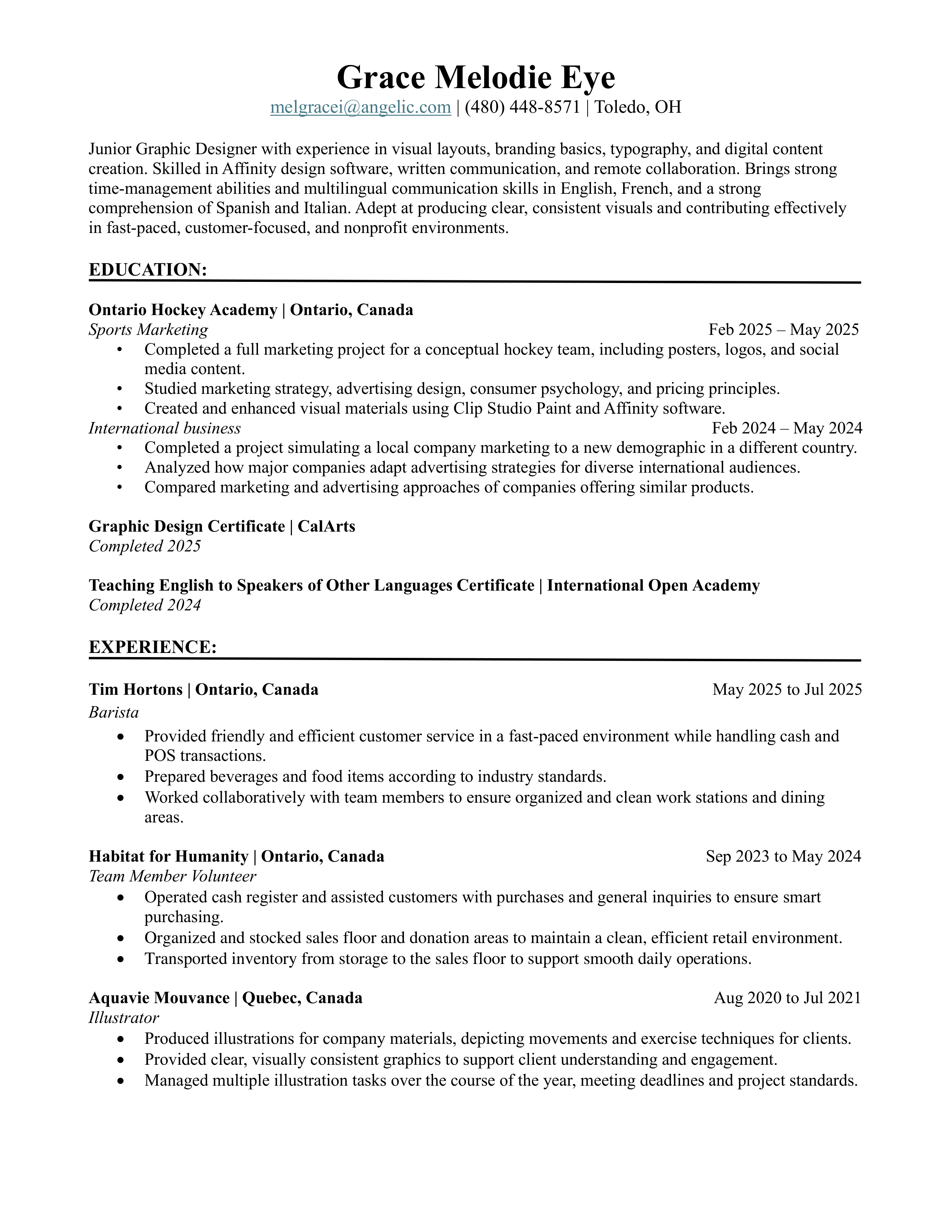
These examples show that I have practiced management skills in both creative and practical environments. My resume supports this because it shows experience with time management, teamwork, customer service, organization, and visual communication.

Transferable Skills

The transferable skills I value most are communication, emotional awareness, teamwork, and problem solving because they influence how people interact, collaborate, and respond to challenges. I’ve realized that leadership is often less about technical ability and more about understanding people and creating healthy dynamics.

Communication is one of the most important skills I’ve developed because it affects trust, clarity, and emotional connection. I’ve learned that people communicate differently depending on stress levels, personality, confidence, and environment. Because of this, I try to communicate in ways that feel clear, calm, and emotionally aware instead of reactive or dismissive.

Teamwork taught me how important emotional dynamics are within groups. A group can technically function while still feeling disconnected, unmotivated, or tense underneath the surface. I’ve learned that healthy teamwork depends on communication, trust, accountability, and emotional respect between members.

I approach problem solving in a very analytical and reflective way. Instead of only reacting to surface-level issues, I usually try to understand the deeper cause of a problem first. This helps me stay calmer under pressure and think more carefully about long-term solutions rather than quick emotional reactions.


I also use technology to communicate, collaborate, organize projects, and create visual work. Since so much modern communication happens online, I think emotional intelligence and communication skills are becoming even more important in digital environments.

My Self-Assessments & Reflection

Self-assessments can be useful because they help me understand my strengths, personality, interests, and areas for potential growth. They support leadership development because self-awareness helps a leader understand how they communicate, make decisions, and respond to challenges.

This assessment helped me understand that I am reflective, observant, and thoughtful. These traits can support my leadership because they help me consider different perspectives before reacting. It also showed me that I may need to keep building confidence when speaking up or taking initiative.

This assessment helped me identify strengths such as creativity, communication, empathy, responsibility, and organization. These strengths support my leadership because they help me work with others, complete tasks, and create a positive environment.

This assessment helped me connect my interests to possible future pathways. Since I am interested in graphic design and visual communication, it showed me that leadership skills are still important in creative careers because designers often need to manage projects, communicate with clients, and collaborate with teams.


Overall, these assessments helped me see leadership as something personal. My leadership style is connected to my personality, strengths, goals, and experiences. They also helped me understand that being a leader does not mean being perfect. It means knowing myself, recognizing where I can improve, and continuing to grow.

Artifacts & Evidence

This section includes evidence that supports my leadership, management, and transferable skills. My resume is included here as a reference because it shows my experience in graphic design, customer service, volunteering, organization, teamwork, and communication.


This resume supports my portfolio by showing real examples of planning, organizing, communication, teamwork, and creative skills.


Grace Eye Resume